Why a Cloud Architect Built a Baby Sleep App
In the post announcing my return I mentioned that my partner and I now have two children. What I did not mention is what happened to the few quiet evenings that came with them. Some went into this blog. Most of them, it turns out, went into an app.
It is called Sicher & Geborgen (roughly "safe and secure", in the sense a child feels it), and it is a baby sleep app for German-speaking parents. That is a long way from Azure Virtual Desktop, so this post explains what it is, why it exists, and why some of the next "Case of…" posts will be about a phone app rather than a session host.
I did not build it alone. My partner, Bettina Lehner, is an educator and certified sleep consultant, and the app carries the name of her practice, Sicher & Geborgen. The knowledge and the advice in the app are hers. The engineering is mine. It is a family project in every sense.
What it does
The short version: you log when your child sleeps and wakes, and the app helps you see the day for what it was and guess what comes next.
- One-tap sleep logging, for one child or several, on the phone or straight from the wrist on Apple Watch and Wear OS.
- A next-nap estimate based on wake windows: it starts from age-based ranges and gradually learns the rhythm of your own child.
- Insights on the day, the week and the month, written to explain rather than to grade.
- A knowledge library on infant sleep, attachment and gentle routines, written by Bettina.
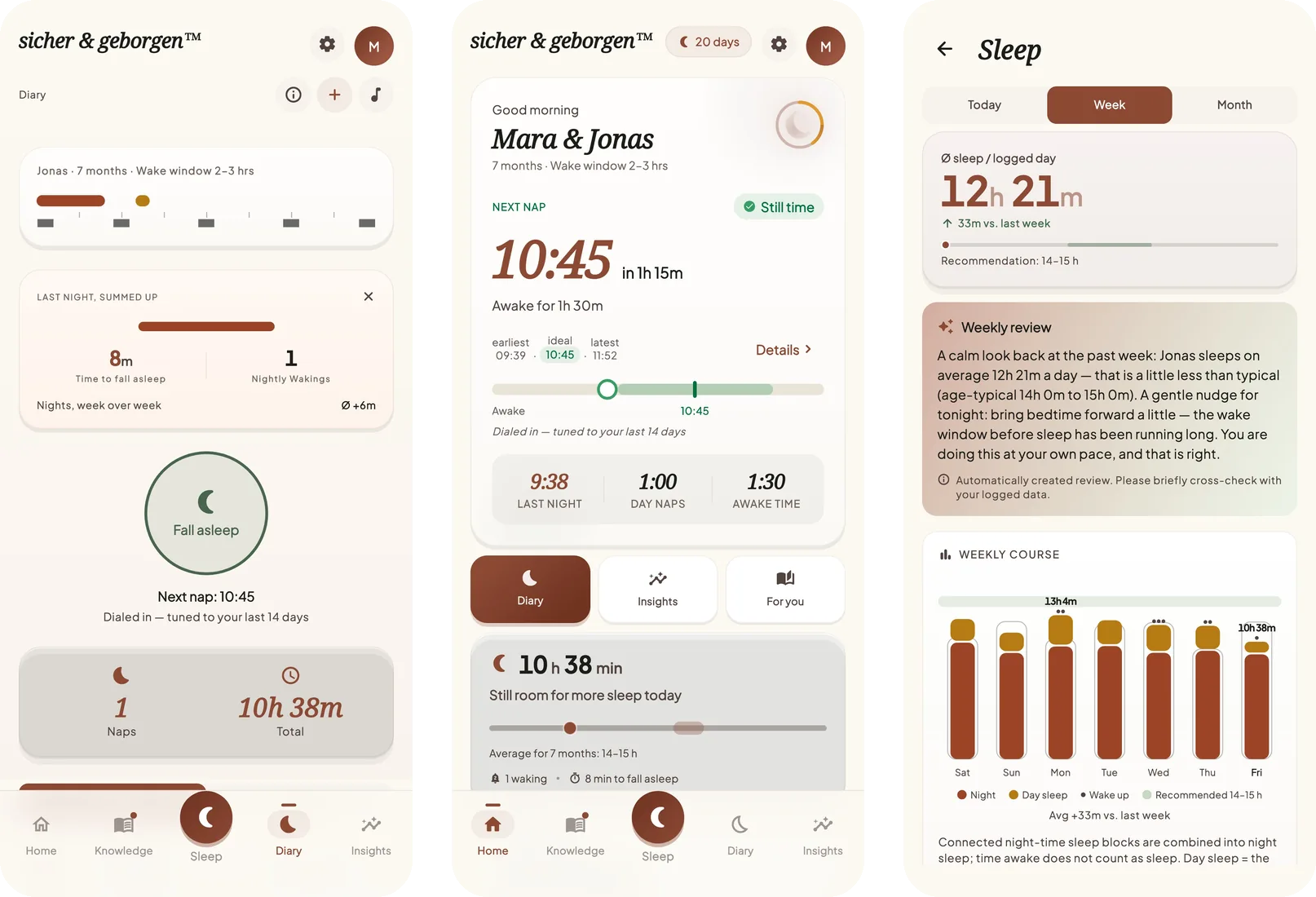
It is aimed at attachment-oriented parents, the ones who would rather understand why the evening went sideways than follow a schedule that promises to fix it. It does not tell anyone to let a baby cry, and it does not hand out scores. The data stays on the phone: there is no account and no cloud sync, and a backup is a file you export yourself.
Technically it is a Flutter app for iPhone, iPad and Android, with native companion apps for Apple Watch and Wear OS. It has been in the App Store and on Google Play since summer 2026.
Why build it at all
The short answer: to help other families. The first months with a baby are full of questions, and most of them come up at night, when there is nobody to ask. If an app can take some of the guesswork out of those hours and leave a parent a little calmer, it is worth building. It is also the reason this blog exists. A lot of what I know came from people who took the time to share it, and this is another way of passing that on.
The method is the one behind most of the toolkit: when a problem keeps coming back, stop solving it by hand. The difference is that a PowerShell script only has to convince me. An app has to convince a tired parent at three in the morning, holding the phone in one hand and the baby in the other.
What it has taught an endpoint engineer
I expected the hard part to be the code. It was not. The hard part was everything around it, and much of it will feel familiar to anyone who runs a fleet of managed devices.
Green tests are not a working release. One build passed 2,272 automated tests and crashed on every iOS launch. Nothing in the test suite ever started the real app on a real device. The rule now is simple: the exact binary that goes to the store gets launched before it is uploaded. Think of it as a pilot ring with one device in it, and the ring is never optional.
Your lab shows up in your telemetry. For a while the analytics showed a surprising number of customers in the United States, for an app with German content. They were my own test emulators. Around half of the "customers" were machines I had started myself. Anyone who has seen lab VMs inflate a compliance report knows this one. You filter by evidence, not by hope.
The second visit matters more than the first. Plenty of people install an app, look around once and get on with their lives. That is normal, and it is not a verdict on the app. What it taught me is to stop polishing the first impression and start asking what brings someone back the next day. In this case it is mostly a well-timed reminder and a first night that is already logged when they return.
"Night" is harder to define than it sounds. A parent wrote in because the app showed four hours of night sleep and eight hours of daytime sleep for a child who had obviously slept through the night. Deciding where a night starts and ends, around split nights, early wakings, time zones and daylight saving time, has produced more specifications than any other part of the app. That one deserves its own case.
How it gets built
I build the app the way I work everywhere else, and AI coding agents are part of that toolset, next to the compiler, the test suite and the emulators. They are set up the way I described in What Goes Where and take on well-defined pieces of work: a search across the code base, a scoped change, a test run. The decisions stay with me: what to build, how it should behave, and whether a change is good enough to ship. Every change is reviewed, and every release is tested on real devices before it reaches a store.
Used that way, the tools buy time, and with two small children time is the scarce resource. They also need clear rules. Most of the rules in those instruction files exist because something went wrong once, and several of those lessons came from this app.
That is also why it belongs on this blog. The tools are different, but the work is not: a problem that keeps coming back, evidence that has to agree with the explanation, and a release that has to work on devices you will never see.
What comes next
The next few cases will come from the app: the launch crash, the phantom customers and the four-hour night. As usual, they will be written so that the method is useful even if you never touch Flutter.
If you are a parent in a German-speaking country and want to try it, you can find it on the App Store and Google Play. And if you have built something outside your day job: what surprised you most once real users got hold of it?